
All 181 outdoor basketball courts in New York.
Find every outdoor court in New York on the map below. Below that, our ranked picks of the 8 courts we keep coming back to.
Add your PUBLIC_MAPBOX_TOKEN to .env and reload to
see 181 courts mapped.
Mapbox returned an authorisation error for the tile fetch. This is almost always a token URL restriction — add this origin to the token's allow list in your Mapbox account, or use an unrestricted token for this environment.
The 8 best outdoor courts in New York.
Our ranked picks of the 8 courts every player in New York should run at least once. The full outdoor atlas (181 courts) sits on the map above.
- By the Editors
- Aug 14, 2025
- Photographs by Editorial

Holcombe Rucker Park
Rucker Park is hallowed ground for a reason. Holcombe Rucker, a NYC Parks teacher, started what is believed to be the city's first annual summer basketball tournament in 1950, then founded a pro summer league in 1954 that pulled NBA stars uptown to play amateurs on the same asphalt. His outreach earned more than 700 college scholarships for his players. The court was renamed Greg Marius Court in June 2017, honoring the man who founded the Entertainer's Basketball Classic here in 1982 and turned the run into a televised cultural event.
The list of legends who played here is its own argument. Wilt Chamberlain first showed up in 1957. Kareem Abdul-Jabbar, Julius Erving, and Nate Archibald all logged minutes during the 1960s and 1970s peak. The current court sits inside P.S. 156 Playground at the base of Coogan's Bluff, between Harlem and Washington Heights, on the lot that opened in 1956.
We watched two summer pickup nights this year. The talent gap between the warm-up runs and the EBC tournament games is enormous, and the crowd on tournament nights is its own scene. The rims are square, the asphalt is uneven, the chain-link fence is patched in places. The court was renovated in 2021 with $520,000 in funding partly from the NBA Players Association, and the National Park Service designated the park as a National Commemorative Site in 2025.
Go to watch, not to dominate.
- Best for
- tournament-level pickup runs
- Busiest
- summer tournament weekends

West 4th Street Courts
The Cage sits directly over the West 4th Street, Washington Square subway station at Sixth Avenue, with the A, B, C, D, E, F, and M lines feeding it. Kenny Graham, a limousine driver, founded the tournament that made the court famous. The pitch is non-regulation small, the sidelines are mostly ignored, and the chain-link fence puts the crowd a few feet from your defender's heels.
Anthony Mason developed his game here. His Prime Time squad won five titles in the early 1990s on this same asphalt. Dr. J, Walter Berry, and Jayson Williams played here. Smush Parker did too. The 'banging inside' style that the Knicks of the 1990s would weaponize traces directly to this court, where ego and elbows do most of the talking.
Tournament officials claim more than 100,000 spectators each summer. We do not have an independent count, but two of our visits in 2025 had standing crowds three deep against the fence. Losing teams do not usually get a second run. Bring your A-game and your wind, and accept that the rim is going to feel small for a while.
Featured in the video game NBA Street V3, which is the most accurate cultural marker we can offer.
- Best for
- physical pickup, watching the run
- Busiest
- weekend summer afternoons

Dyckman Park
Dyckman is technically Monsignor Kett Playground, on Nagle Avenue in Inwood, just south of the Washington Heights line. The tournament that gave the park its modern reputation was founded in 1990 by Kenneth Stevens, Omar Booth, and Michael Jenkins. They built the league as a counterweight to the crack-era turf wars between Inwood's Dominican and Black communities. It started with six teams. It now runs 77 teams across six divisions.
The pro-college division is the reason you have probably heard of it. Kevin Durant, Kyrie Irving, Iman Shumpert, Metta World Peace, Brandon Jennings, Tyreke Evans, JR Smith, Hamidou Diallo, Dennis Schröder, and Naz Reid have all played or watched here. Kyle Anderson hit a game-winning shot at Dyckman in 2016 that locals still bring up unprompted. Baron Davis played the tournament while still on the Knicks.
The City NYC calls Dyckman 'the red carpet of streetball,' and the description holds up. The court itself is full-length, fenced, lit, and renovated in the last few years. The tournament nights have crowds, sponsors, and a serious DJ. The casual pickup at noon is also worth a stop if you want to see what the court is like without the lights.
- Best for
- tournament-level summer runs
- Busiest
- summer tournament nights
 Sponsored
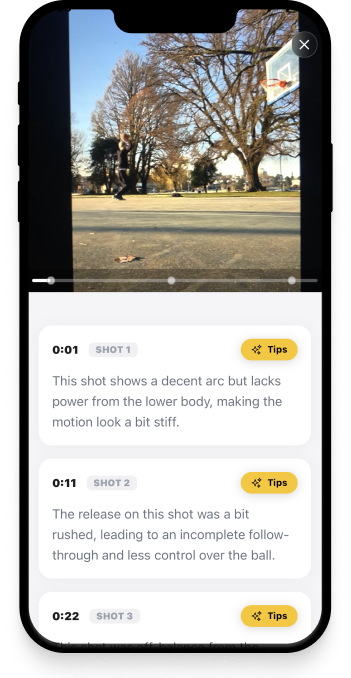
 Your jumpshot, analyzed in 12 seconds.
Film one shot in the app. Get a frame-by-frame breakdown — release angle, elbow alignment, foot placement — plus a personalized drill plan. Free, no signup.

Marcus Garvey Park
Marcus Garvey Park, originally called Mount Morris Park, sits on a steep granite outcropping in central Harlem between East 120th and East 124th Streets. The basketball courts tuck along the eastern edge of the block. The most famous structure in the park is the Harlem Fire Watchtower, built in 1856 and one of the last surviving cast-iron watchtowers in the country, restored and reopened in 2019.
Locals run these courts the way locals run any Harlem park court: hard but friendly, with a few regulars who have been here longer than the renovation that happened around them. The crowd skews younger after school lets out, older on weekend mornings. You are unlikely to find tournament-level competition, but the run is consistent and the rims are forgiving.
On a hot afternoon you can climb the watchtower stairs after a run and look across most of Harlem, including down toward Rucker. The history of the park matters here. Marcus Garvey, the Jamaican-born Pan-African activist whose movement put 'Up You Mighty Race' on the street in the 1920s, has his name on the gates. The renaming happened in 1973.
- Best for
- casual Harlem pickup games
- Busiest
- warm afternoons after school

Morningside Park
Morningside Park sits on the geological seam where the Manhattan schist of Morningside Heights drops sharply down to the older sedimentary rock of Harlem. The basketball courts are along Morningside Drive on the western edge. The slope means the courts get sun in the morning and shade by mid-afternoon, which matters in August.
The park dates to an 1873 Frederick Law Olmsted and Calvert Vaux design, though the version you see today owes more to a 1980s rebuild after decades of neglect. The lake at the southern end has a waterfall fed by a recirculating pump. The park stretches between West 110th Street and West 123rd Street.
Game vibe is mixed. Columbia students from the plateau above mix with the Harlem regulars who live closer. The court runs are friendly. The pickup talent ceiling is moderate. If you want competitive runs, go to Rucker. If you want a chill court with a setting that does not feel like other Manhattan parks, this is the pick.
- Best for
- late afternoon shaded runs
- Busiest
- weekend afternoons, after work

Carl Schurz Park
Carl Schurz Park hugs the East River between East 84th and East 90th Streets in Yorkville, with Gracie Mansion at its northern end. The basketball court is small but well-maintained, and the surrounding park has the highest user rating on this list at 4.7 stars from over 3,400 reviews.
The park is named after Carl Schurz, a 19th century German-American statesman who was at one point a Union general, a US Senator from Missouri, and the Secretary of the Interior. The park's pedigree is reflected in its upkeep. The rims are forgiving, the asphalt is smooth, the fences are intact.
Game style is casual. Yorkville is family-oriented. The runs after work on weekdays bring in finance and tech professionals who want a shoot-around after the office, plus the steady local crowd. You are not going to find a tournament-level run here. You are going to find consistent, polite basketball in one of the prettiest waterfront settings in Manhattan.
The path along the river behind Gracie Mansion is worth the walk after your run.
- Best for
- Yorkville waterfront runs
- Busiest
- weekend mornings

North Meadow
North Meadow is the basketball anchor inside Central Park's 23-acre North Meadow Recreation Area, roughly at the 97th Street transverse. The park has 12 full courts, the largest concentration in Manhattan. The North Meadow Recreation Center next door loans out balls for free with a photo ID, a small detail that matters when you are arriving from the subway empty-handed.
Because there are so many courts, you basically never wait. You can show up on a Saturday afternoon in July and find a half-court that someone is willing to let you join. The talent ceiling per court is variable. The competitive run usually drifts to one or two specific courts on the east side of the meadow.
The fence is full chain-link, the asphalt is in decent shape after a 2019 resurfacing, and the rims are mostly forgiving. The court runs go silent on rainy days and after sunset, when Central Park closes the area. Plan around the park's 1 AM closing time and earlier basketball-specific shutoffs.
- Best for
- high-volume casual pickup
- Busiest
- weekend afternoons

Macombs Dam Park
Macombs Dam Park is in the Concourse section of the Bronx, just east of Yankee Stadium between East 157th and West 161st Streets. The basketball courts are full-length, well-maintained, and benefit from the constant foot traffic that the stadium delivers during the season.
The park was rebuilt in 2010 atop what used to be the old Yankee Stadium footprint. The current stadium opened in 2009 and pushed the park north, with the new courts and running track laid out on the demolition site of the original 1923 stadium. There is genuine baseball history under your feet here.
Game style is competitive on weeknights and family-friendly on weekend mornings. The crowd skews younger and faster after school. On Yankees game days the park is loud and busy, with the stadium crowd flowing through. We have had good runs here, and we have also waited a full hour for a spot when the LEAGUE NYC tournament was using the courts.
- Best for
- Yankee Stadium-adjacent runs
- Busiest
- summer game days, evenings